

HarperCollins has produced its most damning report yet on the collapse of children’s reading for pleasure. It even names the cause. Then it sells you the problem.
The Paradox That Wasn’t Supposed to Be the Headline
In April 2025, HarperCollins gathered publishing industry figures for a Consumer Insights event to launch its latest annual research into children’s reading habits.
Cally Poplak, Managing Director of HarperCollins Children’s Books and Farshore, opened with a statement that should have stopped the room: “I still hear people across our industry use literacy and reading for pleasure as if they mean the same thing. They don’t. In fact, this conflation of the two is a barrier to reading for pleasure. Because if we treat them as the same problem, we risk reaching for the wrong solutions.”
As I read that, I thought “At f*****g last! Someone in the industry is calling out the government for its role in creating the reading crisis!”
Poplak was right. And the data her company – HarperCollins – had compiled was unsparing. Daily reading for pleasure among five to seventeen-year-olds has collapsed to 25% – a fourteen-year low, down from 39% in 2012. The proportion of children who rarely or never read has tripled, from 5% to 15%, in the same period. Among five to ten-year-olds, only 32% frequently choose to read for enjoyment, against 55% in 2012.
The HarperCollins report identified what it called a “reading paradox”: literacy attainment and reading for pleasure are in direct conflict. Schools and parents both recognise reading for pleasure matters, but their focus on literacy skills is, in the report’s own words, “actively undermining it.”
Let me repeat that: “Actively undermining” reading for pleasure.
This is a remarkable finding. Or rather, a remarkable statement. As we’ll come to, this is not new. It is also the headline finding. Not least in The Bookseller: “Literacy focus ‘actively undermining’ reading for pleasure, HarperCollins finds.”
What followed in the HarperCollins report’s recommendations was considerably less remarkable – and considerably more revealing about who, in this conversation, is permitted to be held accountable.
The Accountability Inversion
The report’s central target is parents. Yes, the headline states clearly the literacy focus is the culprit, but then parents are blamed.
Let’s be clear on this: The report’s central target is parents. Three-fifths of three to seven-year-olds are not being read to daily, it finds, and the solution lies in parents creating time and space for reading as a “joyful family tradition.”
Isn’t that a sweet and Dickensian concept. Reading as a joyful fantasy family tradition. In what planet is HarperCollins living?
Let us be precise about who we are actually talking about here. Because by age three, over 93% of children in England are already registered in state-funded early education – nurseries, pre-schools, childminders – for at least 15 hours a week, funded by government as an entitlement. By age four, the overwhelming majority are in full-time Reception class. By five, school attendance is a legal requirement.
The children in the three to seven bracket that HarperCollins singles out as not being read to enough are, in almost every case, spending the majority of their waking weekday hours in an institution specifically funded, staffed, and mandated to develop their relationship with language and literacy.
The framing by HarperCollins (and many government ministers) as a failure of parental bedtime habits is not merely incomplete. It is a precise inversion of the accountability that follows from those facts.
Parents are paying – through taxes or fees – for those institutions. They are doing so, in significant part, because the state has actively encouraged early educational attendance as beneficial to children’s development. The question of who bears primary responsibility for whether a four-year-old encounters reading as pleasure or performance is not, in that context, a close call.
Consider the logic applied to any other professional context. A patient leaves a consultation having been told their health problem is caused by the clinic’s treatment protocol – and is then handed a leaflet explaining how to fix it at home. A car goes back to the garage with a fault caused by the original repair, and the mechanic explains that the owner should do more maintenance. The absurdity is obvious.
Yet this is the precise structure of the reading-for-pleasure debate: schools, operating under a government-mandated assessment framework that the report’s own findings indict, are largely absent from the accountability conversation, while parents – many of them working, most of them without any pedagogical training, many of them exhausted by seven in the evening – are told to fix what they did not break.
This dynamic is not unique to literacy. Any parent who has received an end-of-term school report informing them that their child is falling behind and that parents need to do more will recognise it immediately. Such reports are not communication. They are the institutional equivalent of a tradesperson invoicing for work and then telling the customer to finish the job. When schools issue them, they are not identifying a problem. They are redirecting their own accountability.
Let me throw in a personal note here (Carlo Carrenho says I don’t share enough!). In my school here in The Gambia I personally write the end of term reports for every single child, to be sure no teacher ever tells parents they should be doing more at home, or calls out a child for being behind because of something the school should have fixed.
I have a similar policy for homework. If children want to more at home, that’s great. But if a school says a child needs to do homework, the school isn’t doing its job properly.
And no, we categorially do not teach children to read using synthetic phonics.
The Generation the Report Refuses to Name
There is a dimension of this crisis that neither the HarperCollins report nor the wider policy debate will confront directly: today’s disengaged parents are yesterday’s disengaged pupils.
HarperCollins’s own data shows that Gen Z parents – the first generation to grow up entirely within the post-Rose Review phonics orthodoxy – are almost one in three more likely than Gen X parents to see reading as “more a subject to learn” than a pleasure.
The report notes this with interest. It does not ask why.
The answer is not complicated: these are adults whose own primary schooling conditioned them to experience reading as a performance under assessment pressure rather than as a source of pleasure or meaning. The generational loop is sitting in the data. The report conveniently doesn’t follow it through. Why? We’ll come to that.
This matters for the publishing industry in ways that go beyond sentiment. If the parental generation most likely to buy children’s books is the generation whose relationship with reading was most thoroughly instrumentalised by the school system, then the demand problem HarperCollins is trying to solve is not a marketing problem or a screen time problem. It is a pedagogy problem with a thirty-year lag.
Poplak herself noted the commercial stakes plainly: heavy book buyers – those purchasing sixteen or more children’s titles a year – have been dwindling year on year, now representing just 5% of all children’s book buyers.
The audience for children’s books is not declining because parents love their children less. It is declining because an entire generation was taught, systematically and at state expense, that reading is a test you pass rather than a world you enter.
The Evidence the Government Ignored
In January 2022, Professors Dominic Wyse and Alice Bradbury of UCL’s Institute of Education published the most comprehensive study ever undertaken on phonics and reading instruction – analysing 55 robust longitudinal experimental trials and surveying 2,205 teachers across England.
Their conclusion was unambiguous: the government’s approach to teaching reading was “uninformed” because it was “not underpinned by the latest robust evidence.” For the first time in more than a hundred years, they found, balanced reading instruction was no longer the norm in English primary schools.
The teachers surveyed told their own story. The word “pressure” appeared 97 times in their open comments. One teacher described feeling compelled to “live and breathe phonics.” Another expressed a desire for “reflection on the mass of skills involved in reading rather than solely focusing on phonics.” The Phonics Screening Check – the statutory test in which five and six-year-olds are required to decode pseudo-words like “sut,” “blem” and “meck” – had, the research found, driven “the separation of phonics from other literacy activities, and a reliance on a small number of phonics schemes.”
Wyse and Bradbury’s open letter calling on the government to adopt a more balanced approach to reading instruction attracted over 250 signatories from the academic and teaching community. The government’s response was to complete three rounds of validation of 45 systematic synthetic phonics programmes and declare the process closed. The evidence was noted. The policy was unchanged. The reading-for-pleasure crisis continued.
The Catalogue
HarperCollins nails it. The government’s literacy focus is “actively undermining” reading for pleasure.
Maybe they’ve been reading TNPS.


Or maybe it doesn’t. Because the same company that has identified assessment-driven, skills-first literacy instruction as the primary cause of the reading-for-pleasure crisis publishes, under its Collins imprint, a range of synthetic phonics home-learning materials explicitly designed to extend that instruction beyond the school day.
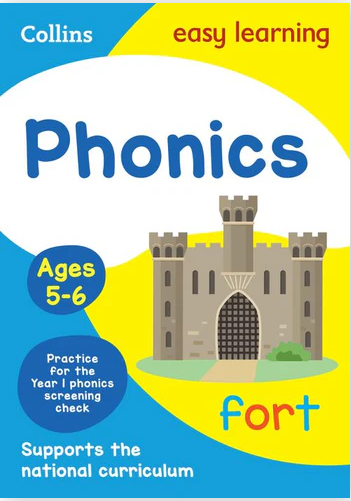
The “Collins Easy Learning” phonics workbook for five to six-year-olds is marketed to parents with the following promise: it includes “questions that allow children to practise the important skills learned at school” and covers “phonics phases 3-5, in preparation for the year 1 Phonics Screening Check.”
Collins also supplies phonics flashcard sets for home use, and – at institutional scale – is a key publishing partner for Little Wandle Letters and Sounds Revised, the fastest-growing DfE-validated synthetic phonics programme in England, currently operating in over 5,500 schools and supplying more than 300 decodable reading books matched to its phonics progression.
To be clear about what this means: HarperCollins publishes research showing that teaching children reading as a skills-and-assessment exercise is destroying their love of books. HarperCollins also publishes the materials parents are sold to continue that exercise at home – materials positioned, almost word for word, as the solution to a child falling behind in the very assessment framework the research indicts.
This is not hypocrisy in the conventional sense. It is the structural consequence of operating simultaneously as a trade publisher, an education publisher, and a research commissioner within a system where commercial interests require you not to disrupt too forcefully.
The lobbying, the partnerships with government literacy initiatives, the Year of Reading for Pleasure – all of it is genuine, in its way. But genuine concern and structural conflict of interest are not mutually exclusive, and the selective application of HarperCollins’s own findings is the evidence of which one wins when they collide.
Screens, Guidance, and the Wrong Diagnosis
The reading-for-pleasure debate has increasingly folded into the broader screen-time conversation, and here too the framing obscures more than it reveals. Screens, like books, are not intrinsically harmful or beneficial. They are delivery mechanisms. The question is never whether children are using screens – they are, everywhere, inescapably – but whether any adult in their environment is offering guidance about how.
The HEPI Student Generative AI Survey 2025 offers a striking parallel at the other end of the educational pipeline. Ninety-two percent of university students now use AI tools regularly, up from 66% the previous year. Forty percent of their institutions actively discourage this use.
As education commentator Dr Sunita Gandhi observed: “the students are navigating one of the most consequential technological shifts in modern history entirely without institutional guidance, because the institutions meant to provide that guidance have not caught up. No policy. No framework. Just students, figuring it out alone.”
The structure is identical to the reading crisis in primary schools in England. A new medium arrives. Institutions respond with prohibition or anxiety rather than pedagogy. Children and young people engage with it anyway, unsupported, and the engagement is blamed on the medium rather than the absence of guidance. The solution – in every case – is not less exposure but more intentional framing.
What the Publishing Industry Needs to Say
The reading-for-pleasure crisis is a publishing crisis. I repeat: The reading-for-pleasure crisis is a publishing crisis.
Not eventually, not by implication – directly and immediately. HarperCollins’s own data shows the commercial consequence: the heavy book-buying audience is shrinking, the light-buying audience is growing, and the economics of selling books to occasional buyers are brutal. The industry’s long-term market is being steadily hollowed out by a pedagogical failure it has, until very recently, been disinclined to name.
Poplak’s statement at the April launch event – that conflating literacy and reading for pleasure means reaching for the wrong solutions – was the most important thing said publicly about children’s publishing in some time. It deserved to be the headline of the report it launched. Instead, the finger was pointed at parents.
The publishing industry, individually and collectively, needs to go further. It needs to engage openly with the 2022 UCL findings that the government buried.
It needs to acknowledge the conflict between its education publishing revenue and its trade publishing future.
It needs to make the case – in parliamentary submissions, in public communications, and in the framing of its research – that the Phonics Screening Check and the assessment architecture surrounding early reading are not neutral infrastructure but active contributors to the crisis its data documents.
And it needs to stop selling parents the test-prep workbooks while telling them bedtime reading should be joyful.
Parents are not the problem here.
The paradox HarperCollins identified is real. Resolving it will require more honesty than the report that named it was permitted to contain.
This post first appeared in the TNPS LinkedIn Analysis Newsletter.